
Reviewed By Rozia Malik, MS Clinical Psychology October 18, 2026
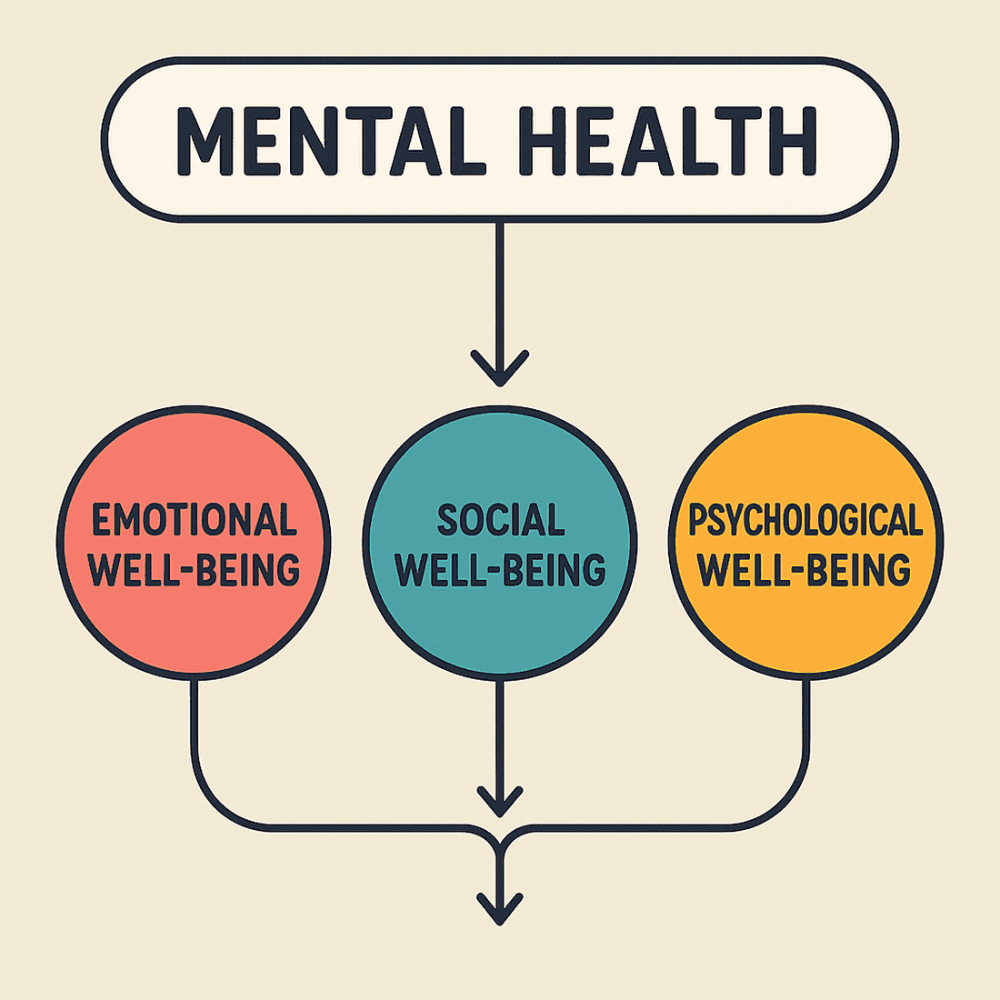
The three key aspects of mental health are emotional well-being, psychological well-being, and social well-being. Together, they shape how you think, feel, and act. They also affect how you handle stress, how you treat other people, and how you make choices.Mental health is more than having no mental illness. The World Health Organization (WHO) describes it as a state of well-being that lets you cope with the normal stresses of life, use your abilities, learn and work well, and take part in your community. Think of it as three areas of your life that all need care. This guide explains each one in plain words, with examples, warning signs, and simple habits that help.
Quick answer: the 3 aspects of mental health
- Emotional well-being: how you notice, understand, and handle your feelings
- Psychological well-being: how you think about yourself, your life, and your future
- Social well-being: how connected you feel to other people
Where does this three-part idea come from? Psychologist Corey Keyes described good mental health as feeling well, functioning well, and connecting well. Many public health groups use the same three words today.
What is Mental Health?
Mental health is not a switch that is either on or off. It sits on a scale. A person with a diagnosis can still do well in many parts of life. A person with no diagnosis can still struggle. Your place on that scale can also change with sleep, stress, loss, health, and the people around you.
The numbers show how common this is. The WHO reports that in 2021, nearly 1 in 7 people worldwide, about 1.1 billion, were living with a mental disorder. In the United States, the National Institute of Mental Health (NIMH) estimates that 23.1% of adults, about 59.3 million people, had a mental illness in 2022. Mental health affects everyone: kids, teens, adults, and older people.
The 3 Aspects of Mental Health at a Glance
|
Aspect |
What it means |
When it is going well |
Warning signs |
|
Emotional |
How you notice and handle feelings |
You can name what you feel and calm down after being upset |
Frequent outbursts, feeling numb, or feelings that stay heavy for weeks |
|
Psychological |
How you think about yourself, your life, and your future |
You accept yourself, have goals, and bounce back from setbacks |
Harsh self-criticism, feeling stuck, no sense of purpose |
|
Social |
How you connect with and belong among other people |
You have people to lean on and feel part of something |
Feeling alone or unseen, even in a crowd |
Emotional Well-Being: Handling Your Feelings
What it means: how well you notice, understand, and manage your feelings.
When this aspect is strong, you can name what you feel. You can be upset without being swept away. You also read other people’s feelings better, which makes relationships easier.
Example: your manager criticizes your work and you feel a hot flash of anger. With strong emotional well-being, you notice the anger, take a slow breath, and reply later when you are calm. When it is weak, you might snap, or shut down for the rest of the day.
Warning signs: frequent outbursts, feeling numb, mood swings that feel out of your control, or a heavy mood that does not lift for weeks.
What helps: name the feeling out loud or on paper, pause before you react, and talk to someone you trust. For more, read about emotional fatigue and how to recover and emotional flooding.
Psychological Well-Being: How You Think About Yourself and Your Life
What it means: how you see yourself, your choices, and your future.
This aspect covers self-acceptance, a sense of purpose, the freedom to make your own choices, and the drive to keep growing. Researcher Carol Ryff listed six parts of it: self-acceptance, positive relationships, independence, handling daily demands, purpose in life, and personal growth.
Example: you fail an exam. With strong psychological well-being, you think, “I need a better study plan.” When it is weak, you think, “I’m just foolish,” and you stop trying.
Warning signs: harsh self-criticism, feeling stuck, feeling that life has no direction, or constant “what if” thinking.
What helps: write down one realistic goal for the week. When a harsh thought shows up, ask, “Would I say this to a friend?” Try a few minutes of quiet reflection or meditation. These guides can help: how to build self-esteem, signs of low self-esteem, and growth mindset vs fixed mindset.
Social Well-Being: Feeling Connected
What it means: how connected you feel to other people and to the world around you.
It includes having people to lean on, feeling that you belong, and feeling that you add something to other people’s lives. Good support makes hard times easier to carry, and it is linked to lower levels of depression and anxiety. When people accept you as you are, it also builds confidence.
Example: a friend notices you have gone quiet and sends a message to check in. That small act can make you feel seen.
Warning signs: feeling alone even in a crowd, avoiding people, feeling like a burden, or having no one to ask for help.
What helps: text one person, join a class or group, volunteer, or accept help when someone offers it. If time with people leaves you drained, read why you feel tired after socializing.
How the Three Aspects Work Together
These three areas feed each other. Say you lose your job. Emotionally, you feel shame and fear. Psychologically, your thoughts turn to “I’m a failure.” Socially, you stop answering friends’ calls because you feel embarrassed. Each piece makes the others worse.
The good news works the same way. One small step in one area, like calling a friend, can lift the other two.
Don’t Mix These Up With Other “Threes”
People often confuse the three aspects of mental health with two other ideas:
- The three aspects of health. The WHO has long described health as physical, mental, and social well-being, not just the absence of disease. Mental health is one of those three.
- The biopsychosocial model. This is a model for the causes of health and illness: biological, psychological, and social factors. It is about why things happen. The three aspects on this page describe the parts of mental well-being itself. Learn more in our guide to the biopsychosocial model.
What Can Weaken Your Mental Health?
Mental health is shaped by things inside you and things around you, and the two often mix.
Inside factors:
- Low self-esteem
- Trouble recognizing or expressing feelings
- Limited self-awareness
- Difficulty calming strong emotions
Outside factors:
- Trauma or abuse
- Little or no social support
- Poverty, violence, or unstable living conditions
- Physical illness
The WHO notes that most people are resilient, but people who face hard conditions such as poverty, violence, disability, and inequality are at higher risk of developing a mental health condition.
12 Simple Habits That Support All Three Aspects
|
Aspect |
Habit to try |
|
Emotional |
Name your feeling in one sentence each day |
|
Emotional |
Take a 5-minute pause with slow breathing when you are upset |
|
Emotional |
Let yourself feel the emotion instead of pushing it away |
|
Psychological |
Set one realistic goal for the week |
|
Psychological |
End the day by writing one thing you did well |
|
Psychological |
Spend 5 minutes in quiet reflection or meditation |
|
Social |
Text or call one person you care about |
|
Social |
Join one group, class, or activity |
|
Social |
Ask for help when you need it |
|
Whole body |
Keep a steady sleep routine |
|
Whole body |
Move your body most days |
|
Whole body |
Eat regular meals (see our food and mental health articles) |
For more on handling stress, see the best coping strategies for stress management
Quick Self-Check
Answer yes or no. This is not a test or a diagnosis. It is just a way to see which area may need attention.
- Can I name what I am feeling most days?
- Do I recover from a bad day within a day or two?
- Do I like myself, flaws included, most of the time?
- Do I have goals or things that give my days meaning?
- Is there at least one person I can be honest with?
- Do I feel I belong somewhere, such as with family, friends, a class, or a community?
Questions 1 and 2 point to emotional well-being, 3 and 4 point to psychological well-being. And, questions 5 and 6 point to social well-being. If you answered no to both questions in one area, start there with a habit from the table above.
When to Get Professional Help
Reach out if low mood, worry, or numbness lasts more than two weeks, or if it affects your work, school, sleep, or relationships. A doctor or a licensed therapist is a good place to start.
If you are in the United States and you are in crisis or have thoughts of harming yourself, call or text 988 (the Suicide & Crisis Lifeline). In an emergency, call 911. If you are outside the US, contact your local emergency number or crisis line.
Sources
- World Health Organization. Mental health fact sheet: https://www.who.int/news-room/fact-sheets/detail/mental-health-strengthening-our-response
- World Health Organization. Mental disorders fact sheet: https://www.who.int/news-room/fact-sheets/detail/mental-disorders
- National Institute of Mental Health. Mental Illness statistics : https://www.nimh.nih.gov/health/statistics/mental-illness
FAQs
Emotional well-being, psychological well-being, and social well-being. Together they describe how you feel, how you think about yourself and your life, and how connected you are to other people.
Mental health is about overall well-being. Mental illness is a diagnosable condition. You can live with a mental illness and still have good well-being in some areas, and you can have no diagnosis and still struggle in others.
Physical, mental, and social. The WHO has described health as complete physical, mental, and social well-being, and not only the absence of disease.
No. Emotional well-being is about your feelings and how you handle them. Psychological well-being is about how you think about yourself, your purpose, and your growth.
No. The biopsychosocial model explains the causes of health and illness through biological, psychological, and social factors. The three aspects here describe the parts of mental well-being.
Start small. Pick one habit from the table above, such as naming your feelings, setting one weekly goal, or texting a friend. Steady sleep, movement, and regular meals support all three areas.