
The Four A’s of Stress Management: A Practical Guide (2026)
We all have days when everything feels like too much. A full inbox. Family demands. A to-do list that never shrinks. Stress is not just annoying. Over time, it wears down your sleep, your body, and your mood.
The good news: stress is manageable once you know the right approach.
One of the most practical frameworks for handling stress is the Four A’s: Avoid, Alter, Adapt, and Accept. It’s widely taught in U.S. workplace wellness programs, college counseling centers, and therapy offices. This guide breaks down exactly how to use it.
What Is Stress, Really?
Stress is your body’s reaction to anything it sees as demanding or threatening. That trigger, called a stressor, can be an argument, a deadline, a bill, or even a bad commute.
The American Psychological Association’s 2023 Stress in America survey found that money, the economy, and health concerns remain some of the top stressors for U.S. adults. In other words: you’re not imagining it, and you’re not alone.
Stressors usually fall into a few buckets:
- Emotional — grief, conflict, relationship strain
- Work-related — deadlines, job insecurity, a difficult boss
- Financial — rent, debt, unexpected bills
- Environmental — noise, traffic, a cluttered home
- Social — loneliness, peer pressure, comparison
- Physical — poor sleep, illness, pain
- Life-change — a move, a new baby, a divorce, a loss
Everyone reacts differently. That’s why a personal stress toolkit works better than a one-size-fits-all checklist.
Two Types of Stress You Should Know
Acute Stress
This is the kind of stress that hits fast and passes quickly. You get a last-minute work request, you nearly miss a flight, or you have a tough conversation, your heart races, your palms sweat, and then it’s over. Acute stress is actually normal and can even sharpen your focus in the short term.
The problem starts when acute stress happens too often. When your nervous system is repeatedly activated without proper recovery, it wears you down physically and mentally.
Chronic Stress
Chronic stress lingers. It’s the background noise that’s always there: financial strain that doesn’t go away, a difficult relationship that never resolves, a job that feels meaningless every single day. This type of stress is the dangerous one. Research shows that chronic, unmanaged stress raises the risk of hypertension, weakened immunity, anxiety disorders, and depression.
This is where the Four A’s technique becomes essential.
![Four A's diagram: Avoid, Alter, Adapt, Accept]](https://thoughtmending.com/wp-content/uploads/2025/06/Firefly_Gemini-Flash_4-As-Techniques-of-Coping-Stress-Avoid-Alter-Accept-Adapt-935029-2-300x163.png)
The Four A’s of Stress Management
-
Avoid — Cut What You Don’t Have to Deal With
Start by removing stress that’s optional. Many people say yes too often. They join calls they don’t need to join. They check the news ten times a day, even though it makes them anxious. None of that is required.
Try this:
- List your top 3 stressors this week. Ask: did I actually have to deal with this?
- Say no without guilt. Saying no to one thing means saying yes to something that matters more — your health, your family, your focus.
- Cut chronic negativity. Mute a group chat. Skip the comment section. Set a time limit on news apps.
- Split “must” from “should.” Most to-do lists are full of “shoulds” dressed up as musts.
Example: A Chicago nurse working rotating shifts stopped checking work Slack on her days off. Her stress didn’t disappear, but one steady drain on it did.
-
Alter — Change What You Can
Sometimes you can’t remove a stressor, but you can change how it plays out. This takes some assertiveness and direct communication.
Try this:
- Speak up early. Address a problem before it grows. Staying quiet doesn’t make it go away.
- Set clear boundaries. If you’re always the one who picks up extra work, that pattern won’t fix itself.
- Fix your time management. Break big tasks into small ones. Schedule them realistically.
- Ask for help. Delegating isn’t weakness. It’s strategy.
Example: A remote worker in Austin, Texas, moved his one deep-focus task to 8 a.m., before Slack notifications started. Same job, less friction.
-
Adapt — Change How You See It
When you can’t change the situation itself, you can often change your response to it. Adapting is about adjusting your mindset not in a toxic positivity way, but in a grounded, realistic way.
This is one of the most powerful long-term stress skills you can develop. Cognitive reframing, which is the basis of Adapt, is a well-established technique in Cognitive Behavioral Therapy (CBT) and has strong research support for reducing stress and anxiety.
Practical ways to apply Adapt:
- Use the “long-term lens” test. Ask yourself: will this situation matter in six months? If not, it probably doesn’t deserve your full emotional response today.
- Reframe the challenge. Instead of “I have to do this,” try “I get to prove I can handle this.” Language shapes experience.
- Focus on what you can control. Worrying about things outside your control is exhausting and ultimately pointless. Redirect that energy to your own choices and actions.
- Practice gratitude deliberately. This isn’t about ignoring problems, it’s about broadening your attention. Writing down three things that went reasonably well each day has measurable effects on stress levels (Emmons & McCullough, 2003).
- Adjust your standards where needed. Perfectionism is a stress amplifier. Sometimes “good enough” is genuinely good enough.
Related Read: How to Recover from Workplace Burnout — Psychology-Backed Guide
-
Accept — Let Go of What You Cannot Change
Some stressors simply cannot be avoided, altered, or reframed away. A serious illness. The death of a loved one. An economic downturn. A past mistake you can’t undo.
For these situations, acceptance is not defeat it is the most emotionally mature and psychologically healthy response.
Acceptance doesn’t mean pretending things are fine. It means acknowledging the reality of a situation without being consumed by it. This is the foundation of Acceptance and Commitment Therapy (ACT), one of the most widely supported psychological treatment models today.
Some things can’t be avoided, altered, or reframed away: a serious diagnosis, a death, a layoff, a past mistake. For these, acceptance isn’t giving up. It’s the healthiest response available.
Acceptance doesn’t mean pretending you’re fine. It means facing reality without being consumed by it. This is the foundation of Acceptance and Commitment Therapy (ACT), one of the most well-supported treatment models in psychology today.
Try this:
- Name the feeling. UCLA researcher Dr. Matthew Lieberman found that simply naming an emotion — “I’m angry,” “I’m scared” — lowers its intensity in the brain. You don’t have to fix it. Just name it.
- Talk to someone. A friend, family member, or therapist can help you carry the weight.
- Forgive yourself for what’s outside your control. You’re not responsible for everything that goes wrong.
- Let yourself grieve. Not every stressor has a fix. Some just need time.
Related Read: Emotional Fatigue: Symptoms, Causes, and How to Recover
Quick Reference: Which “A” Fits Your Stressor?
|
Ask yourself |
If yes |
Category |
|
Can I remove this from my life? |
Avoid it |
Change the situation |
|
Can I change how this plays out? |
Alter it |
Change the situation |
|
Can I change how I think about it? |
Adapt to it |
Change your reaction |
|
Do I just have to live with this? |
Accept it |
Change your reaction |
You’ll often use two or three A’s for the same stressor. That’s normal. The goal isn’t zero stress — some stress is healthy and motivating. The goal is cutting the stress that’s optional.
Healthy vs. Unhealthy Ways of Coping with Stress
Not all coping strategies are created equal. Some things feel good in the short term but make stress worse over time.
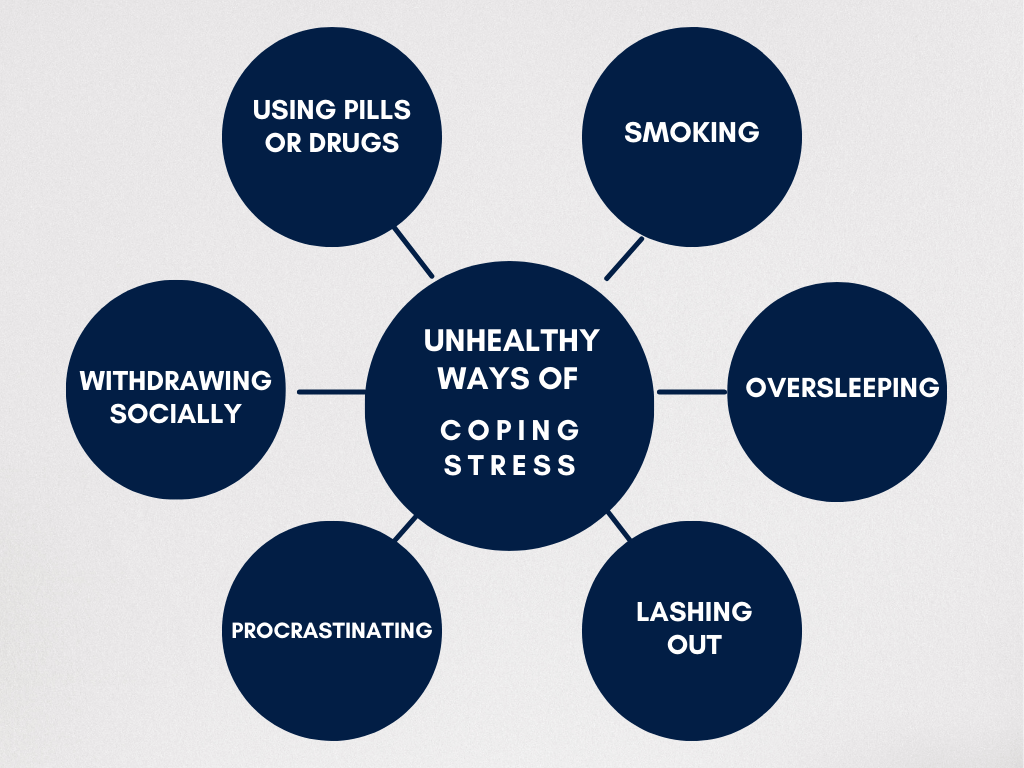
Unhealthy coping patterns to watch for:
- Emotional eating or skipping meals
- Excessive alcohol or caffeine
- Procrastination and avoidance
- Isolating from people who could help
- Doomscrolling or excessive screen time
- Suppressing feelings rather than addressing them
Healthy alternatives:
- Regular physical movement (even a 20-minute walk reduces cortisol)
- Talking through problems rather than ruminating alone
- Quality sleep — 7 to 9 hours is the evidence-backed target for adults
- Mindfulness or breathing exercises
- Journaling
- Connecting with supportive relationships
Related Read: Daily Self-Care Checklist for Mental Health
Unhealthy Ways of Coping with Stress
8 Healthy Ways to Cope with Stress

When to Seek Professional Help
The Four A’s work for everyday stress. But sometimes stress needs more than a self-help framework. Reach out for support if:
- You can’t function at work or home for several weeks
- You’re using alcohol or drugs to cope
- You have physical symptoms like chest pain, frequent headaches, or ongoing insomnia
- You’ve felt hopeless or disconnected for a while
A therapist or psychologist can build coping skills that go beyond what any article can offer. Reaching out isn’t weakness. It’s one of the most adaptive things you can do.
If cost or access is a concern, the SAMHSA National Helpline (1-800-662-4357) is free, confidential, and available 24/7 in the U.S. It can connect you to local mental health and substance use treatment, regardless of insurance.
Related Read: What Are the Best Coping Strategies for Stress Management?
References
- American Psychological Association. (2023). Stress in America 2023. https://www.apa.org/news/press/releases/stress
- Emmons, R. A., & McCullough, M. E. (2003). Counting blessings versus burdens: An experimental investigation of gratitude and subjective well-being in daily life. Journal of Personality and Social Psychology, 84(2), 377–389.
- Lieberman, M. D., et al. (2007). Putting feelings into words: Affect labeling disrupts amygdala activity in response to affective stimuli. Psychological Science, 18(5), 421–428.
- Mayo Clinic. (2024). Stress management: Know your triggers. https://www.mayoclinic.org/healthy-lifestyle/stress-management
- National Institute of Mental Health. (2024). 5 Things You Should Know About Stress. https://www.nimh.nih.gov/health/publications/stress
- SAMHSA National Helpline. https://www.samhsa.gov/find-help/national-helpline

Restaurant AI billing software isn’t just another tech trend – it’s the difference between spending your evening battling spreadsheets and actually having a life outside your establishment.
https://starpos.info/how-ai-powered-billing-software-is-revolutionizing-restaurant-management/
I love it . I would like to learn more
Thanks for information