
Have you ever wondered why people behave the way they do?
Why some people struggle with anxiety while others seem fearless. And why athletes choke under pressure. Why criminals do what they do. Why children learn differently from adults.
Psychology has an answer for all of this and that’s exactly why it’s divided into so many different branches.
Each branch of psychology focuses on a specific part of human behavior and mental life. Together, they form a complete picture of what it means to be human.
In this guide, you’ll discover all the major branches of psychology explained simply such as what each one studies, why it matters, and how it connects to real life.
Let’s dive in.
Related: What is Psychology?
Related: Schools of Thought in Psychology
What Is Psychology and Why Does It Have So Many Branches?
Psychology is the scientific study of the mind and human behavior. It covers everything from how we think and feel to how we act in relationships, at work, and under stress.
As the field grew, researchers realized one approach couldn’t cover everything. A psychologist helping someone with depression uses completely different methods than one working with athletes or courtrooms.
So the field split into specialized branches each with its own focus, tools, and real-world applications.
Today, there are over a dozen well-established branches. Here’s what each one is all about.
Applied Psychology
Applied psychology is the starting point for understanding most branches.
It takes psychological research and theories and applies them to real-world problems. Instead of just studying how the mind works in a lab, applied psychologists use that knowledge in actual settings like workplaces, schools, hospitals, courts, and more.
Think of it this way: pure psychology asks “why?” Applied psychology asks “now what do we do with that?”
Almost every specialized branch you’ll read below is a form of applied psychology.
Clinical Psychology
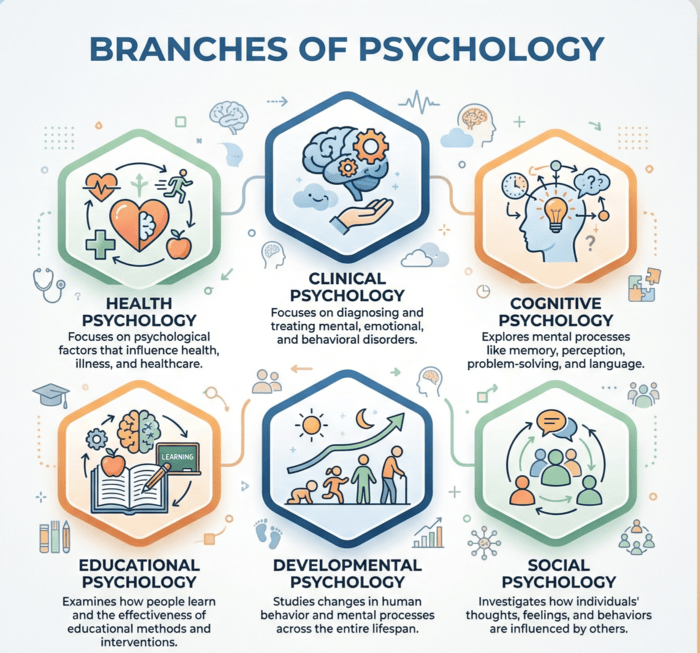
This is probably the branch most people have heard of. Clinical psychology focuses on understanding, diagnosing, and treating mental health conditions. Clinical psychologists work with people dealing with depression, anxiety, trauma, eating disorders, personality disorders, and much more. They use various therapeutic approaches techniques such as cognitive behavioral therapy (CBT), talk therapy, and others to help people manage their struggles and improve their mental well-being.
What makes clinical psychology unique is its range. It covers children, teenagers, adults, and older people. It works across cultures and backgrounds.
If someone is seeing a psychologist for mental health support, they’re most likely seeing a clinical psychologist.
Developmental Psychology
Have you ever noticed how a toddler’s brain works completely differently from a teenager’s and again differently from an adult’s?
Developmental psychology studies exactly that. It looks at how people grow and change across their entire lifespan from birth to old age.
This branch covers physical development, cognitive growth, emotional changes, and social development. It also explores how nature (genetics) and nurture (environment) interact to shape who we become.
Developmental psychologists study milestone moments like language acquisition, identity formation in adolescence, and cognitive decline in older adults.
Their research helps parents, teachers, pediatricians, and policymakers make better decisions for children and families.
Cognitive Psychology
Think about the last time you tried to remember a name and couldn’t and then it popped into your head an hour later. That’s cognitive psychology’s territory.
Cognitive psychology studies the mental processes that happen inside our heads. This includes memory, attention, language, problem-solving, reasoning, and decision-making.
Unlike older approaches that only focused on observable behavior, cognitive psychology looks at the internal processes you can’t directly see.
Researchers in this field use experiments, brain-imaging tools like MRI, and computer modeling to understand how thinking actually works.
The insights from cognitive psychology are used in everything from education to user experience design to treating conditions like OCD and PTSD.
Health Psychology
Here’s something fascinating: your thoughts and emotions directly affect your physical health.
Health psychology studies the connection between mental processes and physical well-being. It examines how stress, beliefs, behaviors, and emotions influence whether people stay healthy, get sick, or recover from illness.
For example, research in health psychology has shown that chronic stress can weaken the immune system. It’s also helped explain why some people follow their doctor’s advice and others don’t.
Health psychologists work in hospitals, clinics, and public health settings. They help patients cope with chronic illness, support behavior change (like quitting smoking), and design better healthcare communication.
Counselling Psychology
Life throws a lot at people grief, relationship problems, career stress, major transitions, and everyday challenges that quietly pile up. Counselling psychology helps people navigate all of this.
Unlike clinical psychology, which often focuses on diagnosing and treating mental disorders, counselling psychology leans more toward supporting overall well-being. It helps people build resilience, find direction, and live more fulfilling lives.
Counselling psychologists work with individuals, couples, families, students, and employees. They’re found in schools, universities, community centers, and private practice.
Their goal isn’t just to fix problems, instead it’s to help people grow.
Bio-Psychology
Want to understand why antidepressants work? Or why a brain injury can completely change someone’s personality?
That’s where biological psychology also called biopsychology or neuropsychology — comes in.
This branch studies the biological basis of behavior. It looks at how the brain, nervous system, hormones, and genetics influence how we think, feel, and act.
Biopsychologists examine things like how different brain regions control different behaviors, how neurotransmitters (brain chemicals) affect mood and motivation, and how genetics play a role in mental health conditions.
This field sits at the crossroads of psychology and neuroscience and it’s growing fast.
Social Psychology
Why do people conform in crowds? Why do individuals sometimes act completely differently in groups compared to when they’re alone?
Social psychology answers these questions.
This branch studies how people’s thoughts, feelings, and behaviors are influenced by others. It covers topics like conformity, obedience, attitudes, prejudice, attraction, and group behavior.
You’ve probably heard of famous social psychology experiments like Stanley Milgram’s obedience study or Philip Zimbardo’s prison experiment. These studies revealed uncomfortable truths about how social situations shape human behavior.
Social psychology has practical applications in marketing, politics, conflict resolution, and public health campaigns.
Related: Causes of Social Change
Education Psychology
Every teacher wants to reach their students. But learning isn’t one-size-fits-all.
Educational psychology studies how people learn and how teaching can be made more effective.
It examines cognitive development, motivation, learning styles, memory, and how emotional factors influence academic performance. It also looks at individual differences, including learning disabilities and giftedness.
Educational psychologists work with schools, curriculum designers, and policymakers to improve how education is delivered at every level from preschool to university.
If a school is redesigning how it teaches reading or managing classroom behavior, educational psychology is guiding those decisions.
Forensic Psychology
What happens in the mind of someone who commits a crime?
Forensic psychology explores the relationship between psychology and the legal system. It studies criminal behavior, helps courts understand offenders, and assists in investigations.
Forensic psychologists may assess whether a defendant is mentally fit to stand trial. They may profile criminal behavior to help law enforcement. They may work with victims of crime or counsel people inside the prison system.
This branch brings psychology directly into courtrooms, police stations, and correctional facilities.
It’s also one of the most popular and most misunderstood ranches, partly thanks to how it’s portrayed in TV crime dramas (the reality is more complex and less dramatic).
Related: What is Forensic Psychology?
Related: Ethical Considerations in Forensic Psychology
Industrial Organization Psychology
You spend a huge portion of your life at work. So it makes sense that psychology has an entire branch dedicated to the workplace.
Industrial-organizational psychology applies psychological principles to work environments. It focuses on improving how organizations function and how employees experience their jobs.
I-O psychologists study things like hiring and selection, leadership development, employee motivation, team dynamics, and workplace well-being. They also look at how to reduce burnout and increase job satisfaction.
Companies use I-O psychology to build better cultures, train managers, and improve productivity and looking after employee mental health.
Sports Psychology
Physical talent alone doesn’t make a champion. The mental game matters just as much.
Sports psychology focuses on the psychological factors that affect athletic performance. It helps athletes manage performance anxiety, build mental toughness, stay focused under pressure, and recover from injuries both physical and psychological.
Sports psychologists work with individual athletes and teams across all levels from school sports to Olympic competition. They also study concepts like motivation, goal-setting, visualization, and team cohesion.
Environmental Psychology
Have you ever felt more at peace in a park than in a crowded shopping mall?
That’s environmental psychology in action.
This branch studies the relationship between people and their physical surroundings. It explores how spaces, both natural and built, affect our mood, stress levels, behavior, and cognitive performance.
For example, research shows that access to green spaces reduces stress and improves mental health. Open-plan offices can increase distraction and reduce productivity. Lighting affects sleep and mood.
Environmental psychologists work with architects, urban planners, and public health officials to design spaces that support human well-being.
Political Psychology
Why do people vote the way they do? How does propaganda actually work?
Political psychology bridges psychology and political science. It studies how psychological processes shape political behavior of individual citizens and political leaders themselves.
Topics in this field include voter decision-making, political attitudes, nationalism, propaganda, leadership psychology, and how people respond to political messaging.
It also looks at the flip side: how political systems, policies, and events affect people’s mental health and worldview.
In an era of polarization and information overload, political psychology is more relevant than ever.
Military Psychology
Service members face some of the most extreme psychological pressures imaginable combat, loss, separation from family, and the difficult transition back to civilian life.
Military psychology applies psychological knowledge to military contexts. It helps recruits build resilience, supports soldiers dealing with trauma and PTSD, and helps veterans readjust after service.
Military psychologists also work on selection and training, leadership development, and unit cohesion. Their goal is to keep personnel mentally strong so they can perform their duties and come home whole.
This branch has contributed enormously to what we now know about trauma, PTSD, and resilience in all populations, not just military ones.
Which Branch of Psychology Is Right to Study?
If you’re curious about pursuing psychology, the branch you choose depends on your interests and goals.
Interested in helping people with mental health challenges? Clinical or counselling psychology might be your path.
Fascinated by the brain and biology? Look into biopsychology or cognitive psychology.
Want to work in schools? Educational psychology is a natural fit.
Drawn to crime and law? Forensic psychology is growing fast.
Love the workplace and leadership? Industrial-organizational psychology is in high demand globally.
Each branch offers a unique lens but all of them share the same goal: understanding human beings more deeply.
Final Thoughts
Psychology isn’t a single thing. It’s a vast, interconnected field with branches that touch nearly every area of human life. Furthermore, it transcends every corner of human experience from the therapy room and sports field to the brain scan lab. It quietly shapes our courtrooms, classrooms, and even the decisions we make at the voting booth.
Understanding the different branches helps you see not just what psychology is, but how powerfully it shapes the world around you.
And the more you understand psychology, the more you understand yourself.
