
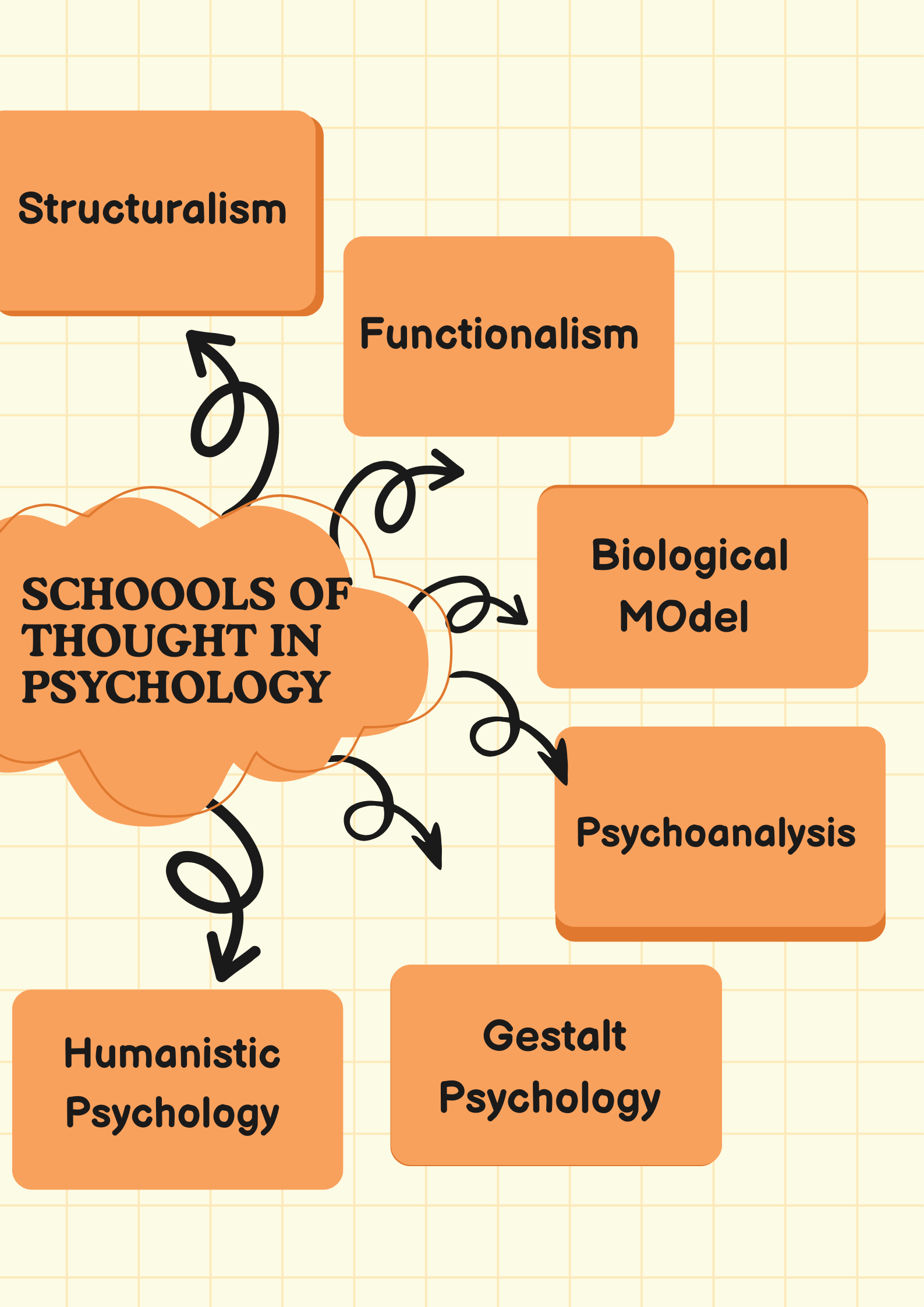
A school of thought in psychology is a shared way of explaining the mind and behavior. There are seven major ones Structuralism, Functionalism, Psychoanalysis, Behaviorism, Humanistic Psychology, Cognitive Psychology, Biological Psychology and Gestalt psychology, often named as an eighth. Each one asks a different question about why people think, feel, and act the way they do. Below, you’ll find what each school believes, who founded it, and a real example of it in action.
Quick answer — the 7 schools of thought in psychology are:
- Structuralism — breaks the mind into basic parts
- Functionalism — asks what the mind is for
- Psychoanalysis — looks at the unconscious mind
- Behaviorism — studies only observable behavior
- Humanistic Psychology — focuses on growth and potential
- Cognitive Psychology — treats the mind like an information processor
- Biological Psychology — links behavior to the brain and body
(Gestalt psychology is often mentioned as an honorable eighth — more on that below.)
What Is a School of Thought in Psychology?
Think of a school of thought as a lens. If you hand seven psychologists the same behavior, a child throwing a tantrum, each one will explain it differently depending on which lens they use. A behaviorist will ask what reward or punishment shaped it, while a psychoanalyst will ask what unconscious feeling it’s covering up. A biological psychologist, meanwhile, will look at what’s happening in the child’s brain and nervous system in that moment.
Psychology split off from philosophy in the late 1800s, and as it grew into its own science, different groups of researchers developed competing answers to the same basic question: what should psychology actually study, and how? Those competing answers became its schools of thought.
Most psychologists today don’t stick to just one school. A modern therapist might blend cognitive techniques, humanistic warmth, and behavioral strategy in a single session. But knowing where each idea came from makes it much easier to understand why your therapist, your psychology textbook, or your favorite psych-explainer video approaches the mind the way it does.
The 7 Schools of Thought in Psychology at a Glance
|
School |
Founder(s) |
Core Idea |
Still Shows Up In |
|
Structuralism |
Wilhelm Wundt, Edward Titchener |
Break the mind into basic elements |
Early cognitive science methods |
|
Functionalism |
William James |
Study what the mind is for |
Applied and evolutionary psychology |
|
Psychoanalysis |
Sigmund Freud |
Unconscious drives shape behavior |
Talk therapy, dream work |
|
Behaviorism |
John B. Watson, B. F. Skinner |
Only observable behavior counts |
Parenting, education, animal training |
|
Humanistic Psychology |
Carl Rogers, Abraham Maslow |
People are wired to grow |
Client-centered therapy, positive psychology |
|
Cognitive Psychology |
Jean Piaget, Ulric Neisser |
Mind works like an information processor |
CBT, memory and AI research |
|
Biological Psychology |
Charles Darwin, Paul Broca |
Brain and biology drive behavior |
Neuropsychology, psychiatric medicine |
-
Structuralism: Breaking the Mind Into Parts
Wilhelm Wundt opened the first psychology lab in Leipzig, Germany, in 1879, and his student Edward Titchener carried the idea to America under the name structuralism. The theory was simple: if you want to understand the mind, break it down into its smallest building blocks such as sensations, images, feelings in the same way a chemist breaks a compound into elements. Wundt’s Leipzig lab did exactly that, running controlled experiments on the basic contents of mental experience.
The main method was introspection: trained observers describing their own inner experience in precise detail. Ask someone to look at an apple and instead of saying “that’s an apple,” they’d describe its exact color, texture, and the sensations it triggers.
Structuralism didn’t last long as a standalone school, since introspection is subjective and two people can stare at the same apple and report completely different things. But it proved psychology could use careful, repeatable methods. That same instinct, breaking experience down to understand it, still shapes how cognitive scientists study attention and memory today.
-
Functionalism: Why the Mind Does What It Does
William James, the first American psychologist, pushed back on Wundt’s approach almost immediately. Instead of asking what the mind is made of, James asked what the mind is for — a shift from studying the structure of consciousness to studying its purpose. Heavily influenced by Darwin, James argued that mental processes exist because they help people adapt and survive.
Take fear. A structuralist would want to catalog exactly what fear feels like. A functionalist asks a different question: what is fear doing for you? The answer in terms of functionalism is a survival signal that helps you notice and avoid danger.
Functionalism pushed psychology out of the lab and into everyday life. It’s the direct ancestor of applied psychology, the branch of the field focused on solving real, practical problems rather than just describing mental states.
-
Psychoanalysis: The Power of the Unconscious Mind
Sigmund Freud built an entire theory of the mind around what we don’t see. His central claim: much of human behavior is driven by unconscious thoughts, memories, and desires, many of them rooted in childhood. Freud pictured the mind as three parts in constant tension — the id (instinct), the ego (reality), and the superego (morality).
His methods were free association, dream analysis, and talk therapy techniques designed to surface what the unconscious mind is hiding. A person who feels inexplicably anxious around authority figures might, through therapy, trace that reaction back to an unresolved experience with a parent decades earlier.
Modern psychology treats a lot of Freud’s specific theories as outdated or unscientific. But psychoanalysis permanently changed how we think about the unconscious, and it directly shaped later thinkers like Carl Jung and Erik Erikson, whose ideas still echo through modern talk therapy.
-
Behaviorism: Watch What People Do, Not What They Think
John B. Watson and, later, B. F. Skinner argued that psychology should study only what can be observed and measured not thoughts, not feelings, just behavior. The APA’s own definition of the field centers on exactly this: observable behavior over internal mental states. In their view, behavior is shaped by rewards and punishments, full stop.
Skinner’s classic example still gets taught in every intro psych class: a rat presses a lever, gets food, and presses the lever again. A child who’s consistently praised for doing homework keeps doing it, not necessarily because of some inner drive, but because the behavior was reinforced.
Behaviorism dominated American psychology for most of the 20th century, and its fingerprints are still all over classroom management, parenting advice, and animal training. Its biggest blind spot was ignoring internal mental life almost entirely which is exactly the gap the next school tried to fill.
-
Humanistic Psychology: People Are Capable of Growth
Carl Rogers and Abraham Maslow built humanistic psychology as a direct pushback against both psychoanalysis (too focused on unconscious damage) and behaviorism (too focused on external conditioning). Their claim: people are naturally driven toward growth, and psychology should study self-esteem, meaning, and potential not just pathology.
Rogers pioneered client-centered talk therapy, where the therapist’s job is to listen without judgment rather than “fix” the client. A counselor helping a student build genuine confidence and set their own goals, instead of just correcting “wrong” behavior, is humanistic psychology in practice.
Maslow’s hierarchy of needs came directly out of this school, and humanistic ideas laid much of the groundwork for modern positive psychology.
-
Cognitive Psychology: The Mind as an Information Processor
By the 1950s and 60s, psychologists like Jean Piaget and Ulric Neisser had grown frustrated with behaviorism’s refusal to study the mind itself. Cognitive psychology treats the mind something like a computer taking in information, processing it, storing it, and retrieving it, and studies how people think, remember, learn, and solve problems.
A classic cognitive question: why can you hold a phone number in your head for ten seconds, then lose it the moment you’re distracted? That’s short-term memory processing, a core cognitive concept.
Cognitive psychology is one of the most active areas of the field today. It’s the backbone of cognitive behavioral therapy (CBT), and it’s central to modern research on decision-making, memory, and the algorithms behind artificial intelligence.
-
Biological (Neuropsychology): The Brain-Behavior Connection
Biological psychology, sometimes called neuropsychology, argues that behavior is shaped by the brain, nervous system, hormones, and genetics. Where humanistic psychology looks at growth and psychoanalysis looks at the unconscious, biological psychology looks at hardware.
Its methods are the most technical of the seven: brain scans (MRI, fMRI), animal studies, and neurological case studies. A well-known example is Broca’s area, a region of the brain tied to speech production damage to it can affect a person’s ability to produce language, which is how researchers first connected specific brain regions to specific abilities.
Modern research increasingly blends biology with psychology, especially in behavioral genetics and neuropsychology, helping scientists understand how brain structure and chemistry shape mood, personality, and mental illness.
8. A Quick Honorable Mention: Gestalt Psychology
You’ll often see an eighth school listed alongside these seven: Gestalt psychology, founded by Max Wertheimer. Its core idea “the whole is greater than the sum of its parts” is almost the opposite of structuralism. Instead of breaking experience into pieces, Gestalt psychology says we naturally perceive things as organized wholes, emerging from the same wave of early scientific psychology as the seven schools above. It’s a big part of why design, art, and UX work still talk about “figure-ground” perception today.
How These Schools Show Up in Therapy Today
These aren’t just historical labels. They still shape what happens in an actual therapy session. A CBT session leans cognitive. A client-centered counselor leans humanistic. A therapist asking about your childhood is drawing, even loosely, on psychoanalytic roots. Many licensed therapists describe themselves as “eclectic” or “integrative” for exactly this reason as they pull the tool that fits the client, not the school they were trained in. If you’re curious how these theories translate into an actual session, psychotherapy breaks down how different approaches play out in the therapy room.
Why These Schools of Thought Still Matter Today
Most working psychologists don’t strictly follow just one school anymore. A therapist might use cognitive techniques to challenge unhelpful thought patterns, humanistic principles to build trust with a client, and behavioral strategies to reinforce healthy habits all in the same session. Understanding where each idea came from makes it much easier to recognize what’s actually happening in your own therapy, your psychology class, or the next pop-psychology article you read.
If you want the bigger picture of how these schools fit into the field as a whole, what is psychology and different branches of psychology are good next reads.
Sources
- Lumen Learning (OER psychology course) — Wundt/Leipzig lab, 1879: https://courses.lumenlearning.com/waymaker-psychology/chapter/reading-structuralism-and-functionalism/
- Lumen Learning — James/functionalism vs. structuralism: https://content.one.lumenlearning.com/introductiontopsychology/chapter/1-1-3-learn-it-early-psychology-functionalism-2/
- APA Dictionary of Psychology — behaviorism definition: https://dictionary.apa.org/behaviorism
- Noba Project — History of Psychology module: https://nobaproject.com/modules/history-of-psychology
