
You are sitting in a meeting, heart beating just a little too fast, mind running through every possible way things could go wrong and then it starts. A dull, squeezing pressure across your forehead. A tightness creeping up the back of your neck. By the time the meeting ends, your head is pounding. Or maybe it happens at night. You lie in bed with racing thoughts that will not stop, and the next morning you wake up with a headache before the day has even started.
If this sounds like you, you are not imagining it. Anxiety genuinely causes headaches. Not as a coincidence. Not because you are weak. But because of a very real chain of events happening inside your brain and body every single time your anxiety kicks in.
Related: https://thoughtmending.com/why-am-i-always-anxious/
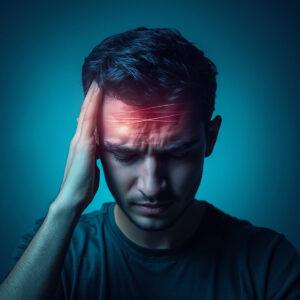
Yes, Anxiety Really Does Cause Headaches
Let us start here, because a lot of people feel like their headaches must have some other explanation. They think: surely head pain needs a physical cause? It does. And anxiety provides one.
According to the National Institute of Mental Health, anxiety affects around 19% of adults in the United States every year. Headaches rank among the most consistently reported physical symptoms in people with anxiety disorders. This is not a vague connection. Anxiety triggers a sequence of measurable, biological changes in your body that lead directly to head pain.
The reason it feels mysterious is that the chain from “anxious thought” to “pounding headache” happens largely without you noticing. Most of the steps are invisible until the pain shows up.
So let’s walk through each one.
Read Also: Chronic daily headache and anxiety
The Step-by-Step Reason Anxiety Gives You a Headache
Step 1 — Your brain detects a threat (real or imagined)
Anxiety starts in the amygdala. It is the part of your brain that acts like a smoke detector. Its job is to scan for danger and fire an alarm the moment it finds something suspicious.
The problem with anxiety is that the amygdala does not always distinguish well between real threats and imagined ones. A difficult conversation, a looming deadline, a social situation you are dreading, a worried thought about the future, the amygdala treats all of them as potential emergencies. It fires anyway. The moment that alarm goes off, your brain shifts into fight-or-flight mode.
Step 2 — Stress hormones flood your body
Your hypothalamus is the control center that links your brain to your body and sends a signal to your adrenal glands. They pump out cortisol and adrenaline. Adrenaline makes your heart beat faster and your breathing speed up. Cortisol keeps the system running on high alert for as long as the threat seems to exist.
Research published in PMC (2025) found that the sustained release of cortisol narrows blood vessels and reduces oxygen flow to the brain. That is one direct pathway to headache pain.
Also Read: https://thoughtmending.com/how-does-stress-affects-health/
Step 3 — Your muscles tighten, especially around your head
Here is where the headache really starts to form.
When fight-or-flight kicks in, your muscles contract. Your body is preparing to either fight or run. The muscles it tightens most are exactly the ones most connected to headache pain: your jaw, your neck, your shoulders, and the muscles across your scalp and forehead.
Most people do not even realize they are doing it. You might clench your teeth slightly. Your shoulders might rise a centimeter toward your ears. The muscles along the back of your neck might pull tight. None of these feel dramatic, but hold them for 30 minutes, an hour, or an entire anxious afternoon, and the accumulated tension becomes a genuine headache.
Think of squeezing a sponge with both hands and just… holding it. Eventually, the sponge would tear. Your neck and scalp muscles do not tear, but they ache and that ache radiates into your head.
Research on trigger points in people with tension-type headaches found a direct link between higher anxiety levels and more active muscle trigger points in the neck, shoulders, and jaw, confirming that this is not just a theory. Anxiety literally increases the physical tightness in those muscles (NCBI, 2017).
Step 4 — Your serotonin levels drop
Serotonin is a brain chemical that does two very important things: it regulates your mood, and it regulates pain.
When you are chronically anxious, your serotonin levels tend to drop. Lower serotonin means you feel worse emotionally but it also means your nervous system becomes more sensitive to pain signals. Things that would not normally hurt start to hurt more. Headaches that might have been mild become severe. Tension that you might have shaken off instead lingers and intensifies.
A 2025 review in Pharmacological Reports (Springer Nature) confirmed that chronically high cortisol levels directly disrupt serotonin production and function, meaning the stress hormones released by anxiety actively make your pain sensitivity worse over time.
Step 5 — The headache makes the anxiety worse
Here is the cruel part. Once the headache starts, it often feeds the anxiety back.
You notice the pain and start worrying about it. Why does this keep happening? Is something wrong with me? What if it is something serious? That new wave of worry activates the same fight-or-flight chain all over again such as more cortisol, more muscle tension, more pain.
This is the anxiety-headache cycle. Anxiety causes the headache. The headache fuels more anxiety. The anxiety makes the headache worse. Without something breaking the loop, it can go on all day.
What Does an Anxiety Headache Actually Feel Like?
Knowing the biology is useful. But you also need to be able to recognize what an anxiety headache feels like because it can be hard to tell apart from other types of head pain.
The most common description:
- A dull, constant pressure not sharp, not throbbing
- Feels like a tight band wrapped around your head, especially across the forehead and temples
- Can also feel like weight or heaviness pressing down on the top of your skull
- Soreness or stiffness in the neck and shoulders alongside the head pain
- Sometimes a deep ache behind the eyes
- Pain on both sides of the head, not just one
Less common but still possible:
Some people with anxiety do not get tension-type pain they get full migraines. Anxiety is one of the most well-documented migraine triggers. For these people, anxiety-driven headaches come with throbbing pain on one side of the head, nausea, and strong sensitivity to light and sound. A 2025 systematic review in Headache: The Journal of Head and Face Pain confirmed that behavioral interventions targeting anxiety including CBT and relaxation training significantly reduce migraine attack frequency in people where anxiety is a primary driver.
One key sign it is anxiety-related:
The headache shows up during or shortly after periods of worry, stress, or emotional tension and it tends to ease when you genuinely relax. If your headache patterns follow your anxiety patterns, that is not a coincidence.
7 Specific Situations Where Anxiety Headaches Strike
- Before a difficult conversation The anticipation of confrontation, feedback, or an uncomfortable talk with someone keeps your muscles tense for hours before a single word is spoken. The headache arrives well before the conversation does.
- During overthinking spirals at night You lie in bed. Your mind replays conversations, runs through worst-case scenarios, and refuses to switch off. Your neck muscles tighten on the pillow. You wake up with your head already aching before the day has started.
- After a long day of holding it together You spend an entire day suppressing anxiety like performing calm, staying focused, pushing through. By evening, your body has been clenched all day and the headache arrives the moment you finally stop.
- During social situations that make you nervous Social anxiety is a significant driver of anxiety headaches. The sustained alertness, the hyperawareness of how you are coming across, and the effort of managing every interaction keep your nervous system in fight-or-flight for extended periods.
- When you are waiting for news Medical results, job applications, exam grades and the prolonged state of uncertainty and anticipation is exactly the kind of sustained anxiety that drives headaches. Your body holds the tension of not-knowing in its muscles.
- On high-pressure workdays Deadlines, decisions, difficult emails, back-to-back meetings, and sustained mental load combined with physical tension from sitting at a desk creates the perfect conditions for a tension-type anxiety headache by the end of the day.
- When you try to rest but cannot switch off The days when you know you should relax but your brain refuses to stop. Those can be some of the worst days for anxiety headaches, because the contrast between wanting to rest and not being able to makes the anxious arousal more noticeable and more frustrating.
How to Stop an Anxiety Headache Right Now
These are not vague suggestions. These are specific actions you can take in the next five minutes
Unclench your jaw immediately
Jaw clenching is one of the primary drivers of anxiety headaches, and most people do it without realizing. Let your mouth relax slightly open. Let your tongue drop from the roof of your mouth. Feel the difference in your face and temple muscles.
Do a 4-7-8 breath
Breathe in through your nose for 4 counts. Hold for 7 counts. Breathe out through your mouth for 8 counts.
The extended exhale is the important part. It activates your parasympathetic nervous system. It is sometimes called the “rest and digest” system. Even one or two rounds of this breath can measurably reduce your heart rate and begin to lower the cortisol in your system.
Drink a full glass of water immediately
Anxiety disrupts your awareness of basic body needs. Dehydration makes every type of headache significantly worse. When cortisol is high, your kidneys excrete more water. Drink now, then drink again in twenty minutes.
Apply pressure to the web of your hand
Find the fleshy area between your thumb and index finger. Press firmly on that spot with the opposite thumb and hold for 30–60 seconds. This is the LI-4 acupressure point, and while the research on it is modest, many people find it meaningfully reduces tension headache intensity. At worst, the focus of doing it helps interrupt the anxiety cycle briefly.
Step outside for five minutes
Natural light and fresh air do something screens cannot replicate. Even a short walk outside shifts your nervous system. Your breathing deepens, your muscles loosen slightly from the movement, and you give your brain a genuine break from the inputs that were feeding the anxiety.
How to Reduce Anxiety Headaches Long-Term
Short-term relief helps. But if anxiety headaches are a regular part of your life, you need to work on the anxiety itself because the headaches are a symptom, and treating symptoms without addressing the cause is like mopping the floor while the tap is still running.
Cognitive Behavioral Therapy (CBT)
CBT is the most research-backed psychological treatment for both anxiety disorders and anxiety-related headaches. It works by helping you identify and change the thought patterns that keep your anxiety running.
A major 2025 systematic review and meta-analysis published in Headache: The Journal of Head and Face Pain found that CBT, relaxation training, and mindfulness-based therapies each meaningfully reduce headache frequency in adults where anxiety and stress are primary triggers. This is not a soft finding. Rather, it is the conclusion of dozens of clinical trials across thousands of patients.
The Society of Clinical Psychology confirms that combining CBT with relaxation techniques produces more headache relief than relaxation alone for tension-type headaches.
You do not have to have a diagnosed anxiety disorder to benefit from CBT. If you get frequent anxiety headaches, it is worth exploring either with a therapist, through structured self-help resources, or via online therapy platforms.
Progressive Muscle Relaxation (PMR)
PMR is a technique where you deliberately tense and then release muscle groups across your body, one at a time. It sounds simple. It is remarkably effective.
By deliberately creating and then releasing muscle tension in a controlled way, you teach your body the difference between contracted and relaxed and you give your nervous system a safe, controlled experience of releasing tension. Over time, people who practice PMR regularly notice they carry less background tension in their muscles throughout the day, which means fewer anxiety headaches.
Consistent, quality sleep
Anxiety and poor sleep are deeply intertwined. Anxious thoughts disrupt sleep. Poor sleep makes anxiety worse. And both poor sleep and anxiety independently increase headache frequency.
Protecting your sleep is one of the highest-leverage things you can do for anxiety headaches. This means consistent sleep and wake times, no screens for 30 minutes before bed, a room that is cool and dark, and a wind-down routine that genuinely signals to your nervous system that the day is over.
Regular physical movement
Exercise is one of the most effective anxiety reducers available without a prescription. It burns off the cortisol and adrenaline that anxiety accumulates. It loosens the muscle tension in your neck and shoulders. It releases endorphins that improve mood and raise pain tolerance. And it improves sleep quality, which helps break the sleep-anxiety feedback loop.
You do not need intense workouts. Twenty to thirty minutes of brisk walking most days of the week produces measurable reductions in anxiety over time.
Reduce your caffeine gradually
Caffeine is a stimulant that raises cortisol and increases nervous system activation. Same like, an already-anxious nervous system does not need. It also disrupts sleep, causes rebound headaches when it wears off, and can trigger panic-like symptoms in people with anxiety disorders.
If you are dealing with frequent anxiety headaches, gradually reduce your caffeine intake. But, not cutting it suddenly, which causes withdrawal headaches.
The Cycle You Need to Break
Here is the thing that makes anxiety headaches so persistent: the cycle reinforces itself.
Anxiety causes the headache. You notice the headache and start worrying about it. The worry intensifies the anxiety. The intensified anxiety tightens the muscles more. The headache gets worse. That makes you more anxious and makes the headache worse.
Breaking this cycle requires working at two points simultaneously: calming the physical tension in the moment, and addressing the anxiety patterns over time. One without the other only gets you halfway.
The physical relief tools in this article handle the first part. The long-term approaches like CBT, sleep, movement, reducing stimulants handle the second. Use both.
When Should You See a Doctor?
Most anxiety headaches are uncomfortable but not dangerous. However, you should seek medical attention if:
- Your headaches are sudden and extremely severe especially if they feel like the worst headache you have ever had
- You have headaches more than 15 days per month
- The pain comes with fever, stiff neck, confusion, vision changes, weakness, or numbness
- You recently had a head injury
- You are taking pain medication more than two or three times per week (this can cause medication overuse headaches)
- Your headaches are significantly affecting your work, sleep, or daily life and are not improving
A doctor can rule out other causes and help you build a plan. There is no award for suffering through something that is treatable.
References
- PMC / National Library of Medicine. (2025). Chronic stress and headaches: The role of the HPA axis and autonomic nervous system. https://pmc.ncbi.nlm.nih.gov/articles/PMC11852498/
- Treadwell, J.R., et al. (2025). Behavioral interventions for migraine prevention: A systematic review and meta-analysis. Headache: The Journal of Head and Face Pain. https://pubmed.ncbi.nlm.nih.gov/39968795/
- Springer Nature / Pharmacological Reports. (2025). The cortisol axis and psychiatric disorders: An updated review. https://link.springer.com/article/10.1007/s43440-025-00782-x
- NCBI / PMC. (2017). Relationship of active trigger points with related disability and anxiety in people with tension-type headache. https://www.ncbi.nlm.nih.gov/pmc/articles/PMC5380302/
- Society of Clinical Psychology, Division 12 APA. (2025). Cognitive behavioral therapy for chronic headache. https://div12.org/treatment/cognitive-behavioral-therapy-for-chronic-headache/
- American Migraine Foundation. (2022). Behavioral treatment of migraine. https://americanmigrainefoundation.org/resource-library/behavioral-treatment-migraine/
- Blossom Health. (2026). Can anxiety cause headaches? https://www.joinblossomhealth.com/blog/can-anxiety-cause-headaches