
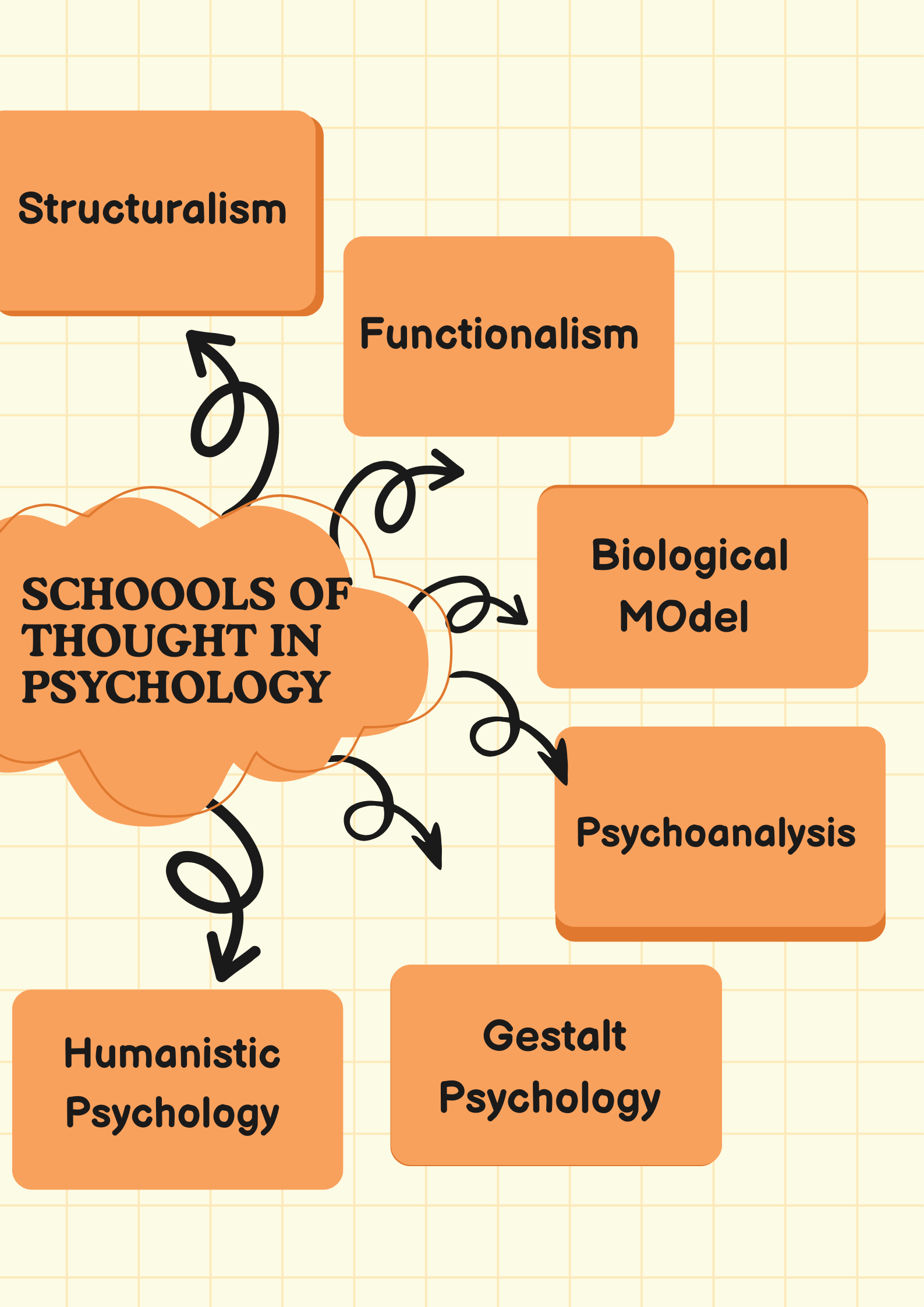
A school of thought reflects how a group of people sees the world. They share similar ideas and perspectives. We find these viewpoints in philosophy, belief systems, social movements, economic theories, and cultural trends. Psychology is no different. Over time, different perspectives have developed to explain human nature and behavior. These “schools of thought” help us understand behavior, the mind, and personality from various angles. Here is a short introduction to the different schools of thought in psychology. These schools appeared at different times in history. They help people understand psychology and human behavior patterns.
Related: What is Psychology?
Related: Different Branches of Psychology
Structuralism: First School of Thought in Psychology
Founders: Wilhelm Wundt & Edward Titchener
Main Idea: Mental processes can be understood by breaking them down into basic elements like sensations, images, and feelings. Even today, cognitive science uses a similar approach when studying things like attention and memory. Structuralists believed that by using introspection and observing people’s reactions, they could understand the structure of the mind.
Methods Used: Introspection (examining one’s own thoughts and inner experiences) to study the structure of mind
Example: Analyzing how you feel when you see a rose its color, smell, and the memories it triggers.
Functionalism
Founder: William James
Main Idea: This school of thought was influenced by Darwin’s theory and viewed psychology as the study of how humans adjust to their environment through learning. It believed that mental processes exist because they help people adapt and survive. This perspective also laid the foundation for applied psychology by focusing on how the mind works in real-life situations.
Methods Used: Observation, mental-function analysis.
Example: Understanding how fear helps you avoid danger.
Biological Psychology
Influential Contributors: Charles Darwin (influence), Paul Broca
Main Idea: Behavior is shaped by the brain, nervous system, hormones, and genetics. It emphasized the person more than environment and other factors in explaining behavior. Current research combines biology with psychology in fields like neuropsychology and behavioral genetics.
Methods Used: Brain scans (MRI), animal studies, and neurological examinations.
Example: Aggression linked to brain injury or an imbalance of neurotransmitters.
Psychoanalysis/Psychodynamic School of Thought ofTh Psychology
Founder: Sigmund Freud
Main Idea: Behavior is influenced by the unconscious mind, early childhood experiences, and hidden desires. Modern therapy still uses psychodynamic concepts, but in more evidence-based and less rigid forms.
Methods Used: Dream analysis, free association, case studies.
Example: Someone may develop anxiety due to unresolved childhood conflicts they are unaware of.
Behaviorism
Founders: John B. Watson, B. F. Skinner
Main Idea: Psychology should focus on observable behavior, rather than thoughts. Rewards and punishments shape behavior. Behaviorism strongly influenced education and animal training techniques.
Methods Used: Experiments, reinforcement, conditioning, and punishment.
Example: A child behaves well because they receive praise or rewards.
Humanistic Psychology
Founders: Carl Rogers, Abraham Maslow
Main Idea: People are naturally good and strive to grow. Focus on self-esteem, personal meaning, and reaching one’s potential. Humanistic ideas strongly influenced modern positive psychology.
Methods Used: Talk therapy, personal-growth strategies.
Example: A counselor helps a student build confidence and set goals.
Cognitive Psychology
Founders: Jean Piaget, Ulric Neisser
Main Idea: Studies how we think, remember, solve problems, and learn. Cognitive psychology is central to today’s AI, decision-making studies, and memory research.
Methods Used: Experiments, memory tests, observations.
Example: A student performs better using mind maps because they strengthen memory connections.
Gestalt Psychology
Founders: Max Wertheimer, Wolfgang Kohler
Main Idea: The whole is more than the sum of its parts. we perceive patterns and wholes, not isolated pieces. Gestalt principles are widely used in design, UX, and advertising today.
Methods Used: Visual perception and pattern-recognition studies.
Example: Seeing a face in simple shapes (like a smiley emoji) rather than just individual dots and curves.

1 comment on “Different Schools of thought in Psychology”