
Children do not always have the words for what they feel. A five-year-old cannot easily explain why they feel anxious before school, or angry after a fight with a sibling. Play gives them another way to say it. Play therapy uses toys, games, and simple activities so children can show, rather than tell, what is going on inside. A trained therapist watches how a child plays, guides certain activities, and helps the child build skills like naming emotions, managing anger, and coping with worry.
According to the Association for Play Therapy, the professional body that trains and credentials play therapists, this approach has been used with children for decades and remains a core method in child mental health care.
This article walks through eight play therapy techniques therapists use most often, and what each one is designed to help with
-
The Feeling Word Game

Direct questions like “how do you feel?” often do not work well with kids. Many children go quiet, get defensive, or simply do not recognize the emotion they are feeling.
A game changes that. The Feeling Word Game lowers a child’s guard by turning the conversation into play. It works well for children with conduct issues, ADHD, or anxiety, and it gives a therapist a safe way to ask about topics a child might otherwise avoid.
-
Color-Your-Life

This technique gives children a simple, visual way to talk about their emotions. Each color stands for a feeling, and the child fills in a page to show what they have been experiencing.
Learning to manage emotions happens in three steps. First, a child learns to recognize different feelings. Next, they connect those feelings to what is happening around them. Finally, they learn to put those feelings into words.
Color-Your-Life works best for children between 6 and 12, once they can name colors and basic emotions. It fits individual or group sessions, and therapists often repeat it over time to track what has changed. Some therapists adapt it to ask about a specific week, or a specific event, like a house move, a divorce, or a loss.
-
Balloons of Anger
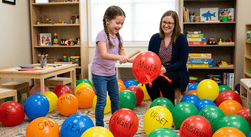
Anger is hard for children to understand, let alone control. Balloons of Anger makes the idea visible. A balloon fills up with air the same way anger builds up inside a child, and if nothing releases the pressure, it can burst and cause harm.
This technique helps two different kinds of children: those who bottle anger up and go quiet, and those who explode outward. A related version, called Bottle Rockets, uses an exploding canister to show the same idea in a more dramatic way.
-
Beat the Clock
“Beat the Clock” is a simple game that helps kids build impulse control and self-control. The idea is straightforward. A child focuses on a task for a set amount of time. To succeed, they must resist distractions and stay on track.
When they complete the challenge, they earn poker chips. These chips can later be traded for a prize. This reward system keeps them motivated. It also helps them feel capable and proud of their effort.
The game works well for both individuals and small groups. It’s especially useful for children who struggle with impulse control.
Other activities follow a similar goal. For example, “Statue,” where the child must stay completely still. Or “Make Me Laugh,” where the therapist and child try to make each other laugh. All of these games build focus, patience, and self-discipline in a fun, engaging way.
-
Bubble Breaths: Relaxation Training

Blowing bubbles is a natural way to teach a child to slow their breathing. It is cheap, easy to set up, and does not feel like “therapy” to the child, which makes it especially useful for younger kids.
Bubble Breaths works in one-on-one or group settings and is particularly helpful for children dealing with anger, anxiety, or general tension. The physical act of a slow exhale, needed to blow a bubble, teaches deep breathing without ever using that phrase.
-
The Worry Can
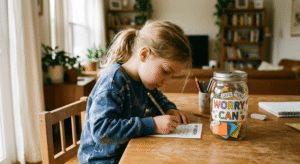
Many children carry worries they do not know how to voice, which can show up as separation anxiety, tantrums, or specific fears. The Worry Can gives those worries somewhere to go.
A child writes or draws a worry and drops it into a can. This makes the fear visible and easier to talk about, either one-on-one or in a group. The same idea works as an “Anger Can” or a “Sad Can,” depending on what the child needs to process.
A related activity is the Garbage Bag Technique. Two paper bags represent “trash,” one for home and one for school. The child decorates the bags, writes down three problems for each setting, and places them inside. In later sessions, the child pulls out one problem at a time and acts it out with toys or role-play. Keeping the play in third person gives the child enough distance to explore solutions without feeling directly exposed.
-
Weights and Balloons
Explaining depression to a child is hard, because ideas like feelings, thoughts, and behaviors are abstract. Weights and Balloons turns those abstract ideas into something a child can see and touch.
This hands-on technique introduces the basic idea behind cognitive behavioral therapy, that thoughts affect feelings, without lectures or clinical language. It works especially well for children dealing with depression, though any child can use it to understand how their thinking shapes their mood.
-
The Power Animal Technique
Children referred to therapy often carry low self-esteem, weak problem-solving skills, and strained relationships with adults or peers. Asking a child directly what strengths they wish they had rarely gets a useful answer.
The Power Animal Technique works around that. The child creates a small “messenger,” an animal, an alien, or a cartoon character, using art materials. The therapist explains that only the child and therapist can see this messenger, who is always with the child and ready to help solve problems. Over time, the child internalizes the qualities the messenger represents, and the tool itself becomes something the child carries in their own thinking, not just something they play with.
Does Play Therapy Actually Work?
Play therapy is not a new idea. A frequently cited 2005 meta-analysis by Bratton and colleagues, reviewing dozens of studies, found generally positive effects on children’s emotional and behavioral outcomes. It remains one of the most-referenced pieces of research supporting play therapy as a legitimate, evidence-based approach, not just a way to keep kids occupied during a session.
When to Consider Play Therapy for a Child
Play therapy tends to help children who show:
- Sudden changes in mood or behavior, such as more anger or withdrawal
- Trouble concentrating or making friends at school
- Difficulty putting feelings into words
- Big life changes, like divorce, a new sibling, or a move
- Reactions to a stressful or frightening event
A licensed child therapist or psychologist can advise whether play therapy fits a specific child’s situation.
Read Also: how to build resilience in kids
how to teach growth midset to kids
